Living in Bulgaria
Life as a expat in Bulgaria
Curious what life in Bulgaria is really like? You are not alone. Living in Bulgaria has quietly become one of Europe's best-value choices, which is why moving to Bulgaria is on so many people's minds right now.
This is the big one: everything you need for living in Bulgaria as an expat, from cost of living and the best places to live to residency, taxes, healthcare and the famous bureaucracy. Whether you are relocating to Bulgaria for the low taxes, the Black Sea coast or a calmer pace, this guide gives expats in Bulgaria the full picture, updated for living in Bulgaria in 2026.
Grab a coffee. This covers a lot.
What is life in Bulgaria like?
Life in Bulgaria means low living costs, a flat 10% tax, a mild climate, mountains and a long Black Sea coast, inside the EU. It suits remote workers, retirees, families and entrepreneurs. The main challenges are the Bulgarian-only bureaucracy and the language, both of which are very manageable with the right local help.
Why people move to Bulgaria
People rarely move here for one reason. It is the combination. Bulgaria is the most affordable country in the EU, with a flat 10% tax, an EU passport's worth of stability, and a landscape that runs from Black Sea beaches to the ski slopes of Bansko. Add fast, cheap internet and a growing IT scene, and you get a place that works for retirees, remote workers, families and entrepreneurs alike. More than 60,000 expats already live here, with the biggest communities in Sofia, Varna and Bansko.
The cost of living
This is the headline. Bulgaria is consistently rated one of the cheapest countries in Europe, with rent, groceries, eating out and transport all well below Western European levels. A single person lives comfortably on roughly €900 to €1,200 a month including rent, and the coast is no exception. From rent to groceries to a coffee by the sea, your money simply goes much further here.
Where to live in Bulgaria
Each place has its own character. The short version:
- Sofia the capital: the biggest job market, expat scene and international schools, with a lively start-up culture.
- Varna on the Black Sea: a coastal city with beaches, a relaxed pace and a strong IT sector. Our home, and where we help you settle.
- Plovdiv: charming, historic and creative, popular with families.
- Bansko: the mountain and ski town with a big digital nomad community.
If the sea and a calmer lifestyle appeal, Varna is where we focus, and where we help you settle in person.
Climate and the seasons
Bulgaria has a pleasant, varied climate. Summers are warm, often 25 to 30 degrees and higher on the coast, while winters are mild near the sea and colder inland, dropping to around 0 to 5 degrees. Spring and autumn are arguably the sweet spot. The variety means you can pick your weather: beach summers on the coast, snowy winters in the mountains.
Housing: renting and buying
Renting is cheap and straightforward, and furnished apartments are common. Buying is where many expats are drawn in, with property prices that look remarkable from Western Europe. One firm rule: never buy without an independent legal and ownership check. Skipping it is one of the most expensive mistakes newcomers make. We arrange viewings and the legal checks so you do not get caught out.
Residency and visas
This is where the path splits. EU, EEA and Swiss citizens can stay freely and simply register their residence locally to settle long term. Non-EU citizens generally get 90 days in any 180 and, to stay longer, apply for a long-stay Type D visa from a Bulgarian embassy before moving, then a residence permit on arrival. After five years of legal residence you can apply for permanent residency. The exact route depends on your nationality and reason for moving, which is exactly the kind of thing we map out for you.
The bureaucracy: EGN and the right order
Here is the part everyone warns you about, and rightly so. The system is slow, paper-based and almost entirely in Bulgarian. Worse, the steps are connected and have to happen in a precise order: address, EGN number, bank account, health insurance, company. Get the order wrong, or bring an uncertified translation, and you lose weeks. It starts with your EGN number, the personal number that unlocks almost everything else, and we make sure each step happens in exactly the right order.
Taxes
Bulgaria runs one of the simplest tax systems in the EU: a flat 10% on personal income, a flat 10% on company profit, and just 5% on dividends. There are social contributions on top of salaries, and VAT is 20%. For higher earners from Western Europe, the difference is dramatic. We explain it all, including residency and double-tax treaties, in our guide to tax in Bulgaria.
Work, business and digital nomads
Local salaries are lower than in Western Europe, so most expats here either work remotely, run their own business or are retired. Bulgaria is especially friendly to founders and freelancers: you can set up an EOOD company quickly and cheaply and pay that flat 10%. The IT and remote-work scene is strong in Sofia and Varna, with fast internet and coworking spaces. See our full walkthrough on how to open a company in Bulgaria.
Banking
You will want a Bulgarian bank account for rent, bills and your company. The honest catch: banks can be cautious with foreigners and sometimes refuse an account without local ties or the right introduction. Having residency, an EGN and a trusted contact at the bank makes the difference between a week of frustration and a single appointment. This is one of the things our local network quietly solves.
Healthcare
Healthcare is a mixed picture. Public care is low cost once you register with the national health fund (NZOK), and private clinics are affordable and of a good standard, which is why Bulgaria attracts medical tourism. The real hurdle is language: most doctors work in Bulgarian only, so finding English-speaking GPs and specialists is far easier with the right contacts.
Schools and family
Bulgaria works well for families. Public schools are free, with textbooks provided, but lessons are in Bulgarian. Many expat families therefore choose international schools, which mostly cluster around Sofia and teach in English or other familiar curricula. Fees there are higher, but children learn in a language they know, which makes the move much smoother.
Transport and getting around
In Sofia and Varna you can live well without a car: public transport is cheap and ride-hailing apps like Bolt operate in the cities. Outside the bigger towns and along the coast, a car becomes much more useful. Inter-city travel relies mostly on buses and trains, which are inexpensive if not always fast.
Language and culture
Bulgarian uses the Cyrillic alphabet, which looks daunting at first but is learnable, and a little effort goes a long way with locals. English is common among younger people, in tourism and in IT, but far less so at government offices and with older generations. Culturally, Bulgaria is warm and hospitable once you are in. One quirk to remember: a nod can mean no and a shake can mean yes.
Safety and staying connected
Bulgaria is generally safe, with low violent crime and cities where people feel comfortable walking at night. As anywhere, basic care against petty theft is sensible. On connectivity, Bulgaria punches well above its weight: home internet is fast and very cheap, mobile coverage is good, and SIM cards from A1, Yettel or Vivacom are easy to pick up.
The pros and cons, honestly
The good
- Low cost of living and a flat 10% tax
- EU member, with sea and mountains
- Fast, cheap internet for remote work
- Safe, and affordable healthcare
The challenges
- Slow, Bulgarian-only bureaucracy
- Language barrier outside the cities
- Lower local salaries
- Banking can be tricky for foreigners
The pattern is clear: the upsides are about lifestyle and money, and the downsides are almost all about paperwork and language. And those are exactly the parts that local help removes.
How to actually move, and how we help
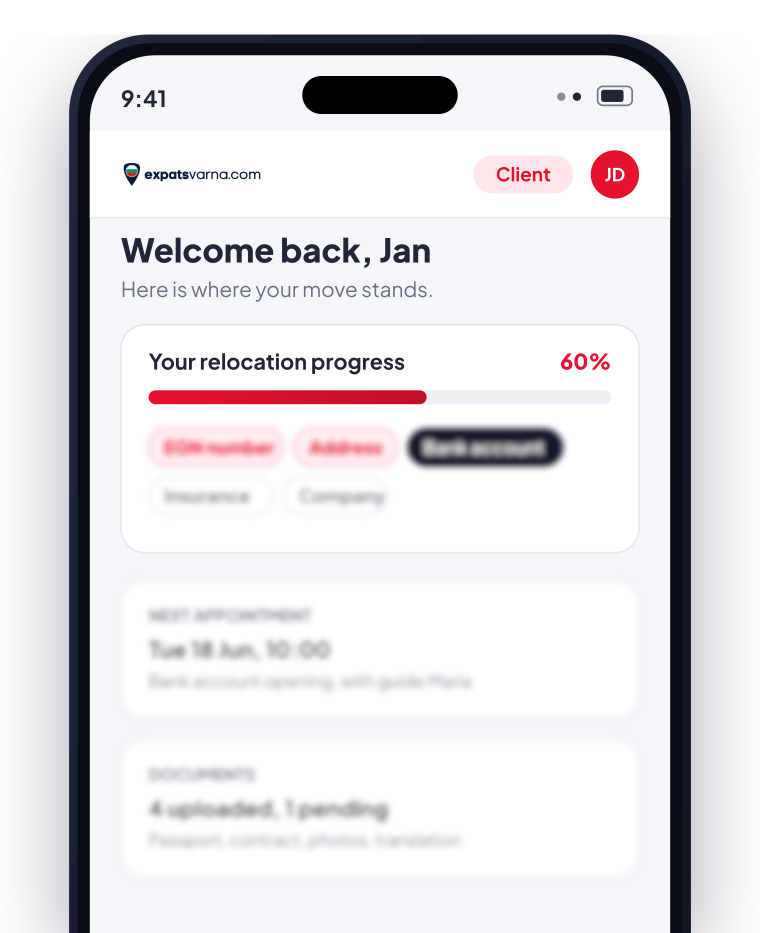
You can do all of this alone. The question is how many weeks and how much stress it costs. We live in Varna, and we handle the whole move with you: residency, EGN, bank account, home, healthcare and company, in the right order. A Bulgarian and English speaking guide goes with you in person to every counter, bank and notary, so nothing gets lost in translation. You can read more about us, and when you are ready, book a free intro call.
Why this matters to us
One of us moved here the hard way, and it took more than three months. Double payments, forms that kept getting rejected, and not knowing the right people to move things forward. It felt like a slap in the face. We would not wish that first impression of a wonderful country on anyone.
So we built Expats Varna to give you the version we wish we had had: fast, fair, and with the right people beside you. Bulgaria is a brilliant place to live. The bureaucracy should not be the thing you remember about arriving here, and with us, it will not be.
What the numbers say
- Bulgaria's cost-of-living index sits around 39 out of 100 on Numbeo, among the lowest in the EU.
- More than 60,000 expats live here, with the largest communities in Sofia, Varna and Bansko.
- Personal and corporate income are taxed at a flat 10%, dividends at 5%.
- Summer temperatures typically reach 25 to 30°C, with mild coastal winters around 0 to 5°C.
"In Bulgaria, nothing is sorted in one go. The bureaucracy is slow, paper-based and almost entirely in Bulgarian. With the right people beside you, it stops being the hard part." From the team at Expats Varna
Why more and more people choose Varna
Bulgaria is the country, but a lot of newcomers end up choosing one city in particular. Varna keeps winning people over, and we understand why, because it is where we live and work too.
- The Black Sea on your doorstep, without giving up a real city with an airport and hospitals
- Lower rents than Sofia, with the very same flat 10% tax
- A growing IT and remote-work scene, fast cheap internet and coworking spaces
- A relaxed, safe pace and a friendly, growing international community
- And us, right here: a local team that handles your move in person, in your own language
It is exactly the kind of local detail we walk you through, in person and in your own language.
Book a free intro call →Life in Bulgaria: frequently asked questions
For many people, yes. It combines a low cost of living, a flat 10% tax, EU membership, a mild climate and both sea and mountains. The main challenges, the bureaucracy and the language, are very manageable with local help.
Bulgaria is one of the cheapest countries in the EU. A single person can live comfortably on roughly €900 to €1,200 a month including rent, with couples and families spending far less than in Western Europe.
The largest communities are in Sofia (the capital), Varna (the Black Sea coast) and Bansko (the mountains). Sofia offers the biggest job market, Varna the sea and a relaxed pace, and Bansko a strong digital nomad scene.
EU citizens can settle freely and simply register their residence. Non-EU citizens get 90 days in any 180 and need a long-stay Type D visa to stay longer, then a residence permit. After five years you can apply for permanent residency.
Bulgaria has a flat 10% tax on both personal and corporate income, plus 5% on dividends, among the lowest in the EU. Social contributions apply on salaries and VAT is 20%.
English is common among younger people, in tourism and in IT, especially in Sofia and Varna. At government offices and with older generations it is mostly Bulgarian, which is why a local guide or interpreter helps so much.
Public healthcare is low cost once you register with NZOK, and private care is affordable and of a good standard. The main challenge is finding English-speaking doctors, since most work in Bulgarian, which local contacts solve.
Yes, Bulgaria is generally considered safe, with low violent crime and cities where people feel comfortable walking at night. As anywhere, basic precautions against petty theft are sensible.